Organisation file
The Bufalino Family
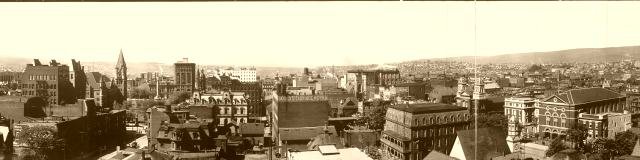
Panorama of Scranton, Pennsylvania, c. 1909 — Library of Congress
The smallest organisation in this archive with national reach ran out of a Pennsylvania coal town of ten thousand people. Its influence came from what the coal region connected to: the garment trucking that moved between New York and the mills, and the Teamsters locals that moved everything else.
Coal, cloth and freight
The family formed among Sicilian immigrants in the anthracite valleys around Pittston and Scranton in the first decade of the twentieth century, in an economy of mining companies, company towns and labour disputes settled privately.
When the New York garment industry moved its sewing out of Manhattan to escape union wages, it moved to those same valleys. The family did not own the dress shops. It controlled the trucking that carried cloth in and finished garments out, which is the same choke point the Lucchese family worked in New York, on a smaller scale and with less competition.
Apalachin
The meeting that exposed the national organisation in November 1957 was held at the home of Joseph Barbara, in Apalachin, New York. Barbara was this family's boss. Russell Bufalino, who succeeded him, was among the men state police identified as they left.
The consequence for the family was the consequence for everyone: a national membership list, a Senate committee, and a federal government that could no longer maintain the organisation did not exist.
After Bufalino
Russell Bufalino held the family from the late 1950s until convictions removed him in the 1980s. He died in 1994 in a nursing home a few miles from where he had run it.
What followed is thin and largely undocumented. The garment trucking that paid for all of it went overseas, the coal economy was already gone, and the organisation shrank with the industries it had attached itself to.
Where it stands
There is very little to report, and the absence is the finding.
No leadership of this family has been prosecuted since Russell Bufalino's own convictions ended his control in the 1980s. The garment trucking that gave a Pittston boss standing in New York went overseas, the anthracite economy was already gone, and no comparable choke point replaced them.
Other families in this archive shrank. This one lost the industry it was attached to, which is a different and more final thing. The record after the 1990s is thin enough that any confident account of who runs it now would be invention.
The Commission 1950–1970
Boss
- Russell "McGee" Bufalino 1903–1994
The Decline 1970–1992
Associate
- Frank "The Irishman" Sheeran 1920–2003
Grouped by the period each man belonged to. A family's chart changes shape from one era to the next, and reading it as a single organisation is what makes it confusing.
Members
Sources
- United States Senate Permanent Subcommittee on Investigations records (1958–1959)
- New York State Investigation Commission report on the Apalachin meeting (1958)
- Pennsylvania Crime Commission reports (1970–1990)
- United States v. Bufalino
- Middle District of Pennsylvania (1977–1981)