Long read
Six Years as Donnie Brasco
An FBI agent spent six years inside the Bonanno family as a jewel thief. The operation ended because the family tried to make him a member, and the men who had vouched for him paid for it.
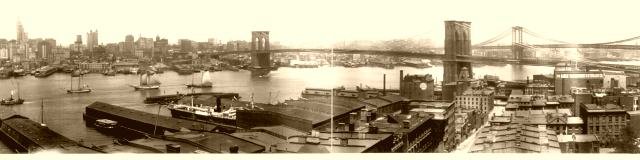
New York from Brooklyn Heights, c. 1911 — Library of Congress
September 1976 · New York and Florida · The Decline
Joseph Pistone was an FBI agent who could drive a truck, handle a boat, speak some Italian and pass as somebody who had grown up around thieves, because he had. In September 1976 he was given a new name and told to go and be a criminal in New York.
The plan was six months. It ran nearly six years, and nothing about how it ended was in the plan.
Becoming nobody
The first thing an undercover operation of this kind has to solve is not courage. It is provenance.
Everybody inside a crew has a history other people can check. Brasco had to have one thin enough to survive questions and vague enough not to be disproved, so he became a jewel thief from Florida with no family in New York and no crew of his own — a man with skills and no attachments, which is exactly the sort of man a crew finds useful and does not examine closely.
He spent months in bars and card games being nobody in particular before anybody found a use for him.
Lefty
The man who eventually did was Benjamin Ruggiero, a Bonanno soldier in his fifties with a gambling problem and a permanent sense of grievance.
Ruggiero vouched for him. He explained the rules, corrected his manners, told him who could be spoken to and how, and complained without pause about a career that had produced twenty-six years of service and no advancement whatsoever.
It is not an introduction. It is a guarantee, and the man who gives it is answerable in the organisation's own terms for whatever the newcomer turns out to be.
That is what makes it the hardest thing for an undercover operation to obtain, and it is why, once obtained, it opens everything. It is also why this story ends the way it does. The FBI did not merely put an agent inside a family. It put an agent inside a family on somebody's personal surety.
For six years the government's window into a New York crime family was largely a disappointed soldier's running commentary on his own life.
Sonny Black
By 1979 Brasco had moved into the orbit of Dominick Napolitano, a capo running a crew from a Brooklyn social club, who was rising while the family around him fought itself.
Napolitano sent him to Florida on the family's business and gave him responsibility that Ruggiero had never been given. What the FBI now had was not a view of one soldier's world but a working position inside the structure — and that is where the operation started to run out of room.
Two things an agent cannot do
In 1981 Napolitano proposed Brasco for membership.
Membership carried a condition. The condition was a killing, which is the requirement the record shows applied generally and which the family applied here.
What it cost the men who vouched
Ruggiero was arrested before the family could reach him, which is very probably the reason he lived. He was convicted, served roughly eleven years, and died of cancer in 1994.
Napolitano was not arrested first. On 17 August 1981 he left his jewellery and his keys with a bartender, went to a meeting in Brooklyn and did not return. His body was found on Staten Island the following year with the hands removed.
The severing is usually read as a penalty for the handshake that brought an agent in. That reading is repeated everywhere and it is an interpretation; what is documented is the injury, not the meaning.
What it produced
More than a hundred convictions, testimony that ran through the middle of the decade, and an open contract on Pistone that the government took seriously enough to matter.
It also produced something the convictions do not measure. Every other inside account of this world was written afterwards, by members, from memory, with a reason to shape it — Valachi in 1963, Bonanno in 1983, Gravano later. This one was produced from inside, in real time, by somebody trained to record accurately and with no stake in how any of the men involved came out of it.
That is the whole value of the case, and it is why the Bonanno family is the best documented of the five: not because it was the most important, but because it was the one that let the wrong man in and then tried to promote him.
The file on them
- Benjamin "Lefty" Ruggiero Soldier
- Dominick "Sonny Black" Napolitano Capo
- The Bonanno Family Organisation
Sources
- Joseph D. Pistone — Donnie Brasco (1987)
- United States District Court for the Eastern District of New York records (1982–1986)
- Selwyn Raab — Five Families (2005)
- New York City Police Department records (1982)