Long read
The Boss Who Held Rallies
Joseph Colombo ran a crime family and a civil rights movement at the same time, drew tens of thousands to Columbus Circle, and was shot in the head at his own rally in front of the cameras he had invited.
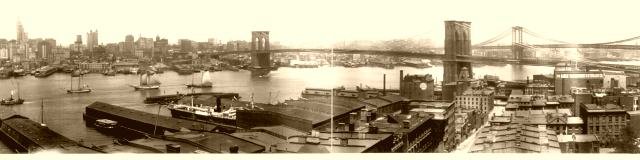
New York from Brooklyn Heights, c. 1911 — Library of Congress
June 1971 · New York · The Commission
Joseph Colombo was given a crime family in 1963 as payment for informing his elders of a plot against them. Seven years later he did the one thing no boss before or since has attempted: he made himself famous on purpose.
The league
In 1970 Colombo founded the Italian-American Civil Rights League. It picketed the FBI's New York office. It held rallies. It argued that the word Mafia was an ethnic slander used to defame millions of people who had no connection to organised crime.
The awkward part, for anyone trying to tell this story simply, is that the underlying complaint was not invented. The portrayal of Italian Americans in American popular culture at that moment was genuinely narrow, the League drew real crowds, and a great many of the people in them were ordinary citizens with no idea who was running it.
A major film studio agreed to drop the word from a picture then in production. The Justice Department stopped using it in press releases.
Those are real outcomes achieved by a real campaign. They were also achieved by an organisation led by a sitting Cosa Nostra boss, in order to make life harder for the agency investigating him. Both halves are true. An account that reports only one of them is not being careful — it is taking a side.
Why the other families hated it
Every principle these organisations claimed to run on pointed the other way.
A boss was supposed to be invisible. Secrecy was not a preference, it was the operating condition, and a man who called press conferences was breaking the only rule that protected everybody else. Carlo Gambino, who had handed Colombo the family in the first place, is reported to have told him to stop.
He did not stop. The League's second rally was scheduled for 28 June 1971 at Columbus Circle.
Columbus Circle
A man carrying press credentials got close to Colombo and shot him three times in the head. He was immediately shot dead by someone who has never been identified.
Colombo survived. He was paralysed and could not speak, and he lived another seven years in that condition before dying on 22 May 1978. Nobody was ever tried for the shooting.
What it settled
The family carried Colombo's name from then on, which is a peculiar outcome for a man whose tenure lasted eight years and ended with him unable to speak.
It also settled the question he had raised. No American boss has attempted public advocacy since. The lesson taken from Columbus Circle was not that the argument about ethnic portrayal was wrong — it was that a man in his position could not be the one making it, and that the organisation would enforce that view itself if the government did not.
The family he left behind spent the following two decades fighting itself, which is a subject for a different page.
The file on them
- Joseph Colombo Boss
- The Colombo Family Organisation
Sources
- Selwyn Raab — Five Families (2005)
- New York City Police Department records (1971)
- contemporary reporting in the New York Times (1970–1971)