Organisation file
The DeCavalcante Family
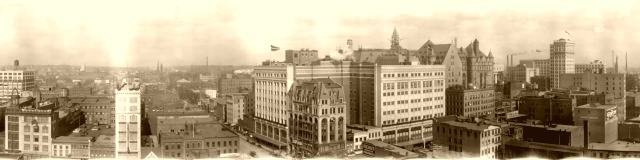
Newark, New Jersey, c. 1912 — Library of Congress
The DeCavalcante family is the only Cosa Nostra family headquartered in New Jersey rather than in one of the five boroughs, and for most of its existence that has defined it. It was small — sixty made members at its height, against several hundred in the Genovese family across the Hudson. New York called it the farm team. It survived anyway, longer than several organisations that laughed at it.
No founding date
Most reference works give the family a founding year. This one does not, because the record does not support one. What is documented is a Sicilian criminal network operating in Elizabeth and Newark from the 1910s, drawn largely from immigrants out of Ribera in Agrigento province, and its gradual recognition as a distinct family with a seat of its own rather than a New York outpost. Stefano Badami is the first leader named with any confidence, and he was already established when he appears in the record.
The Ribera connection outlasted everything else. Members referred to themselves as being from the Ribera family long after the town had stopped meaning anything operationally, and the Elizabeth social club that served as a headquarters for decades was named for it.
A storefront club named for a town in Agrigento province that many of its members had never seen. It was the family's headquarters for decades and it is the address that recurs through the surveillance record more than any other.
Members called themselves the Ribera family long after the name had stopped describing anything except themselves.
The tapes
Between 1961 and 1965 the FBI bugged four locations connected to the family, including the Kenilworth office of the plumbing and heating supply firm run by its boss, Simone Rizzo DeCavalcante. Roughly two thousand pages of transcript were filed in federal court in Newark and made public in June 1969.
A microphone in the office of a plumbing and heating supply firm. The boss of a Cosa Nostra family ran that firm, took his meetings there, and talked there for four years without knowing anyone was listening.
Roughly two thousand pages reached the public docket in June 1969.
Nothing like it had been public before. Joseph Valachi had described the structure of Cosa Nostra to the Senate in 1963 from memory, six years after the fact; the DeCavalcante transcripts were the organisation talking to itself, at length, without knowing anyone was listening. They record induction ceremonies, Commission politics, disputes over construction contracts, and a great deal of complaining. They are the reason a small New Jersey family is one of the best-documented criminal organisations in American history.
Riggi and the unions
John Riggi took the family in 1982, and under him it did what it was actually good at. Riggi had spent twenty-five years as business agent of Laborers Local 394 in Elizabeth, and the family's money came from control of construction labour: no-show jobs, sweetheart contracts, and payments from builders who wanted work to proceed on schedule.
He was convicted of extortion and labour law violations on 20 July 1990 and went to prison, where he stayed for most of the next two decades. He did not give up the title. The family spent the 1990s being run by acting bosses reporting to a man in a federal medical centre, which is a structure that works until it does not.
December 1999
On 2 December 1999 federal agents arrested more than thirty members and associates in a racketeering and murder case that took in most of the active leadership. Within weeks the acting boss, Vincent Palermo, agreed to cooperate — the highest-ranking member the family had ever lost. In October 2000 he pleaded guilty to four murders and seven murder conspiracies. The capo Anthony Rotondo followed him.
What was left has been prosecuted repeatedly since. The family still exists on paper. It has not been a serious organisation since the century turned.
The family in fiction
Two screen organisations are routinely traced back to this family. The evidence behind them is not equal, and the difference is the point.
The Sopranos is the documented case, and it is documented in a way nothing else in this archive is. A federal recording device caught two members discussing the programme eight weeks after it premiered, working out whether it was supposed to be them. The exchange is on the record because one of the men was later questioned about it under oath.
The second is the Pegorino family of Alderney in Grand Theft Auto IV: a small New Jersey outfit in terminal decline, run by a boss who cannot get the established families to take him seriously and who destroys himself reaching for a seat at their table. Players have drawn the comparison since 2008, and the resemblance is close.
Documented. Members of this family discussed The Sopranos on a federal recording made on 3 March 1999, and the exchange entered the public record through trial testimony in 2003.
Not documented. No statement from the makers of Grand Theft Auto IV establishes this family as a source for the Pegorinos, and no source consulted here does either.
A resemblance filed as a resemblance is worth something. A resemblance filed as a fact is worth nothing.
There is a reason both keep landing on the same place. There was only one Cosa Nostra family in New Jersey. Any fiction that wants a small, proud, permanently overlooked outfit living in the shadow of New York is going to arrive at something shaped like this one, whether it started here or not.
Where it stands
The family was written off after 1999, when its acting boss and a capo both became government witnesses. It was not finished.
In March 2015 the FBI arrested ten members and associates in New Jersey on charges running from cocaine distribution to conspiracy to commit murder. A capo, Charles Stango, was recorded arranging a killing with two men he took for contract killers and who were federal agents; he was sentenced to ten years.
Reporting since then describes Charles Majuri, who sat on the ruling panel that Vincent Palermo dominated in the late 1990s, as the family's boss. No court has found it.
What the 2015 case shows is narrower and more interesting than a headline about the Sopranos family still going: sixteen years after the collapse there were still enough members to charge ten of them, still a structure to seek permission from, and still an argument about who was entitled to call himself made.
The Golden Age 1933–1950
Boss
- Stefano Badami Unknown
The Commission 1950–1970
Boss
- Nicholas Delmore Unknown
- Sam "The Plumber" DeCavalcante 1912–1997
Underboss
- Frank Majuri Unknown
The Decline 1970–1992
Boss
- John "Johnny Boy" Riggi 1925–2015
Modern 1992–present
Acting boss
- John D'Amato Unknown
- Vincent "Vinny Ocean" Palermo 1944– Informant
Consigliere
- Stefano "Steve" Vitabile Unknown
Capo
- Anthony "Tony" Rotondo 1955– Informant
- Charles "Big Ears" Majuri Unknown
- Giacomo "Jake" Amari Unknown
Grouped by the period each man belonged to. A family's chart changes shape from one era to the next, and reading it as a single organisation is what makes it confusing.
Members
Subject
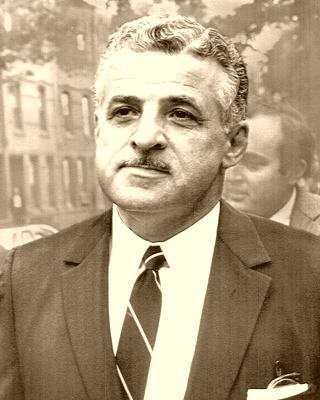
Stefano Badami
Stories
- The Man Who Took Off His Mask A robbery at the World Trade Center, three men who forgot about the lift camera, and the informant the DeCavalcante family spent two years trying to make.
- The Year the Family Had No Boss An acting boss of the DeCavalcante family was killed in 1992 for a reason nobody wrote down at the time. What replaced him was a committee, and the committee lasted the rest of the decade.
Sources
- Selwyn Raab — Five Families (2005)
- Scott M. Deitche — Garden State Gangland (2017)
- Federal Bureau of Investigation — DeCavalcante electronic surveillance transcripts (released 1969)
- United States v. Palermo and others
- District of New Jersey (1999)
- New Jersey State Commission of Investigation reports
- United States Attorney for the District of New Jersey press releases (2015–2016)
- United States v. Stango
- District of New Jersey (2015)