Long read
The Man Who Took Off His Mask
A robbery at the World Trade Center, three men who forgot about the lift camera, and the informant the DeCavalcante family spent two years trying to make.
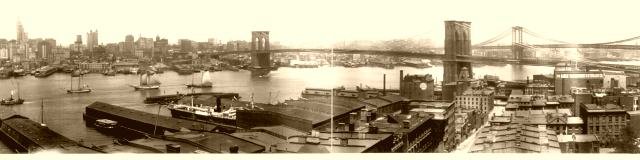
New York from Brooklyn Heights, c. 1911 — Library of Congress
January 1998 · New York and New Jersey · Modern
Ralph Guarino was not a made man and was never going to be one on merit. He was an associate on the edge of the DeCavalcante family, a man with a record and a reputation for schemes, and in the winter of 1998 he had a good one.
A cash shipment moved through the World Trade Center. Guarino knew the route, he knew roughly when, and he knew he could not do it himself. So he hired three men.
The lift
The robbery worked. The three men walked out with well over a million dollars in cash, which is a substantial sum by any standard and an enormous one for a crew of this quality.
Then they got into a lift, decided they were clear, and took off their masks in front of the camera mounted in the corner of the ceiling.
Federal agents had names within days. The three were arrested. Guarino, who had organised it and touched none of it, was arrested shortly afterwards.
The offer
What the government had was a man facing a long sentence who was not a member of anything and had no standing to protect.
What it wanted was inside the only Cosa Nostra family in New Jersey. Guarino agreed, and for the next two years he carried a recording device into rooms where the DeCavalcante family conducted its business.
A made man's conversations are guarded, because a made man knows he is a target and behaves accordingly. An associate is background. He drives, he runs errands, he is present while other people talk and nobody stops talking when he walks in.
The FBI had spent decades trying to get microphones close to the people who mattered. What it had here was a man those people did not consider worth being careful around, standing next to them, several times a week, for two years.
They tried to make him
The strangest part of the case is what the family did next.
Guarino was earning. He brought in money, he was useful, he did what he was asked, and by the standards the organisation actually applied — as against the ones it talked about — that made him exactly the sort of man who should be proposed for membership.
The acting boss, Vincent Palermo, moved to have him made.
The government now had a problem that has no clean answer in any manual: its informant was about to be inducted into the organisation he was informing on. The ceremony did not happen in the end, and the reasons are procedural rather than dramatic — the books were not open, and then there was no longer time.
Joseph Masella
Running alongside all of this is a smaller story that ends worse.
Joseph Masella was a DeCavalcante soldier who owed money — to bookmakers, to other members, to people who had stopped finding it funny. A man in debt inside an organisation like this is not merely embarrassed. He is a liability, because debt is exactly the lever the government uses, and everyone around him knows it.
In October 1998 he was shot on a golf course in Brooklyn. He lived long enough to be asked who did it and declined to say, which is the one part of the code he kept.
December
On 2 December 1999 federal agents arrested more than thirty members and associates of the family. The case drew on wiretaps, on physical surveillance, and substantially on two years of recordings made by a man the organisation had considered making a member.
Within weeks Palermo was cooperating. Anthony Rotondo followed. The family has not functioned as a serious organisation since.
The tapes, the plea agreements, the trial testimony of 2003 and the sentencing records. That is the whole basis for this page.
There are livelier versions of this story in circulation, with better dialogue. They are not sourced, several of the men involved are alive, and this archive is not going to improve on the record for the sake of a scene.
Why it is here
Because the DeCavalcante family was destroyed not by an informant at the top but by one at the bottom, recruited by accident, out of a robbery that failed for the most avoidable reason in the history of the form.
Vincent Palermo's decision to cooperate is the more consequential act and it is covered in his file. But he was only ever in a position to be arrested because three men in a lift, holding somebody else's money, decided the job was over before they had left the building.
The file on them
- Vincent "Vinny Ocean" Palermo Acting boss
- Anthony "Tony" Rotondo Capo
- The DeCavalcante Family Organisation
Sources
- United States v. Palermo and others
- District of New Jersey (1999)
- United States District Court for the District of New Jersey trial testimony (2003)
- Scott M. Deitche — Garden State Gangland (2017)
- Federal Bureau of Investigation consensual recordings (1998–1999)