Long read
Six Weeks Before the Trial
Paul Castellano was killed on a midtown pavement at rush hour without the Commission's approval, eleven months before the Commission itself went on trial. Both facts belong to the same story.
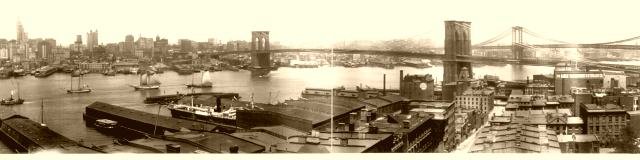
New York from Brooklyn Heights, c. 1911 — Library of Congress
December 1985 · New York · The Decline
Paul Castellano had a court date. He and the heads of three other New York families were defendants in a racketeering case that named the Commission itself as the enterprise, and the trial was coming.
He did not reach it. On the evening of 16 December 1985 he and Thomas Bilotti were shot outside a steakhouse on East 46th Street, in a crowded street, at the top of the evening rush.
Two clocks
The killing is usually told as a story about ambition, and it is one. But the timing is not arbitrary, and two separate things had run down at once.
The first was internal. Aniello Dellacroce, the underboss whose authority held the family's street crews in place, had died of cancer on 2 December. Castellano did not attend the wake. For men who had spent nine years believing their boss regarded them as beneath him, that was not a surprise so much as a confirmation.
The second was the case. Castellano was going to trial, tapes from a microphone in his own house were going to be played, and conviction was a realistic outcome.
The rule that existed for exactly this
Killing a boss without the Commission's approval was the single prohibition the Commission had been created to enforce. It is the whole reason the body existed: after 1931, disputes at that level were supposed to be decided rather than shot.
This was done in public, at rush hour, in midtown Manhattan, by men who then walked into the crowd.
There are quieter ways to kill a man and the people involved knew all of them.
A midtown pavement at six in the evening is not a lapse in planning. It is a statement that the body which would have had to authorise this was not in a position to do anything about it — and eleven months later, when eight of its members were convicted in a single trial, that turned out to be correct.
What followed
John Gotti took the Gambino family within weeks and ran it with a visibility no American boss had attempted since Joseph Colombo held rallies in 1970.
It worked for a while. He was acquitted three times and became a public figure on the strength of it. In 1992 he was convicted of racketeering and of ordering this killing, largely on the testimony of his own underboss, and died in federal custody in 2002.
On 19 November 1986 the men Castellano would have sat beside in court were each sentenced to a hundred years.
Why it is here
Because the two events are usually filed separately — one a gangland murder, the other a landmark prosecution — and they are the same story told from opposite ends.
The Commission spent fifty years as the mechanism that made these organisations governable. In December 1985 a boss was killed in front of witnesses without its consent, and in November 1986 a jury was persuaded it existed and convicted its members for belonging to it. Within a year the body was demonstrated to be both unable to enforce its own central rule and real enough to send its members to prison for life.
The file on them
- Paul "Big Paul" Castellano Boss
- The Gambino Family Organisation
Sources
- New York City Police Department homicide records (1985)
- United States v. Gotti
- Eastern District of New York (1992)
- United States v. Salerno and others
- Southern District of New York (1986)
- Selwyn Raab — Five Families (2005)